Chand Baori in Abhaneri village in eastern Rajasthan, India, is one of
the most overlooked landmarks in the country. It is one of the oldest
stepwell in Rajasthan, and is considered to be among the biggest in the
world. Chand Baori looks like anything but a well. This incredible
square structure is 13 stories deep, and lined along the walls on three
sides are double flight of steps. 3,500 narrow steps arranged in perfect
symmetry descends to the bottom of the well 20 meters deep to a murky
green puddle of water. Built during the 8th and 9th century by King
Chanda of Nikumbha Dynasty, provided the surrounding areas with a
dependable water source for centuries before modern water delivery
systems were introduced. As the green water at the base attests, the
well is no longer in use, but it makes for an interesting stop-over to
an architecturally impressive structure that is over 1000 years old.
There’s also a temple adjoining the well for visitors to explore.
Chand Baori is the oldest stepwell in Rajasthan, having been constructed in the 8th-9th centuries A.D. It is 19.5 meters, or roughly 64 feet, deep. The overwhelming majority of its surface area consists of steps—thousands of steps—all of which lead down to the water table, turning weekly water-gathering trips by local families into a communal spectacle, a social event framed by this extraordinary act of excavation and architecture.
Google map location:

Stepwells, also called bawdi or baori, are unique to India. These wells have steps built into the sides that can be descended to reach the water at the bottom. Stepwells are generally larger than common wells and are often of architectural significance, just like Chand Baori.
The well’s sheer endlessly appearing geometric complexity made of stairs and steps ensured that Rajput people had access to water at any time of the year, and from all sides. The reasons behind building such an elaborate step well is not fully clear. Some believe it was used as a water harvesting site. Rajasthan is a dry place, and hence, every ounce of water is precious. The large mouth of the well functioned as a rain catching funnel that contributed to the water seeping in from the porous rock at the bottom. In addition to conserving water, Chand baori also became a community gathering place for the Abhaneri locals. The townsfolk used to sit around the step well and cool off during the summer days. At the bottom the well the air is always about 5-6 degrees cooler than at the top.
The steps surround the well on three sides while the fourth side has a set of pavilions built one atop another. The side that has the pavilions have niches with beautiful sculptures including religious carvings. There is even a royal residence with rooms for the King and the Queen and a stage for the performing arts.
Chand Baori was featured in the movie The Fall and also made a small appearance in Christopher Nolan’s blockbuster The Dark Knight Rises.
The well is now a treasure managed by the Archeological Survey of India.
As said, Chand Baori is the oldest stepwell in Rajasthan, having been constructed in the 8th-9th centuries A.D. It is 19.5 meters, or roughly 64 feet, deep. The overwhelming majority of its surface area consists of steps—thousands of steps—all of which lead down to the water table, turning weekly water-gathering trips by local families into a communal spectacle, a social event framed by this extraordinary act of excavation and architecture.
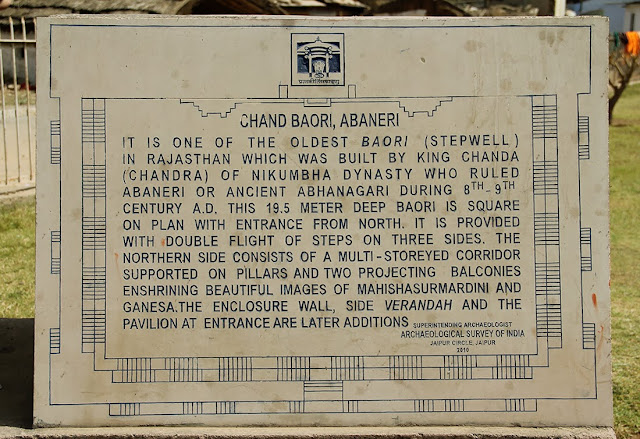
Taking information straight from the sign that greets you upon arriving at the stepwell—
&
The well suddenly appears there, its own horizon line, like a landslide of masonry, a sinkhole stabilized by stairs, and the vertiginous sense of being drawn down into the maw of this place is extraordinary.
Chand Baori is the oldest stepwell in Rajasthan, having been constructed in the 8th-9th centuries A.D. It is 19.5 meters, or roughly 64 feet, deep. The overwhelming majority of its surface area consists of steps—thousands of steps—all of which lead down to the water table, turning weekly water-gathering trips by local families into a communal spectacle, a social event framed by this extraordinary act of excavation and architecture.
Google map location:

Stepwells, also called bawdi or baori, are unique to India. These wells have steps built into the sides that can be descended to reach the water at the bottom. Stepwells are generally larger than common wells and are often of architectural significance, just like Chand Baori.
The well’s sheer endlessly appearing geometric complexity made of stairs and steps ensured that Rajput people had access to water at any time of the year, and from all sides. The reasons behind building such an elaborate step well is not fully clear. Some believe it was used as a water harvesting site. Rajasthan is a dry place, and hence, every ounce of water is precious. The large mouth of the well functioned as a rain catching funnel that contributed to the water seeping in from the porous rock at the bottom. In addition to conserving water, Chand baori also became a community gathering place for the Abhaneri locals. The townsfolk used to sit around the step well and cool off during the summer days. At the bottom the well the air is always about 5-6 degrees cooler than at the top.
The steps surround the well on three sides while the fourth side has a set of pavilions built one atop another. The side that has the pavilions have niches with beautiful sculptures including religious carvings. There is even a royal residence with rooms for the King and the Queen and a stage for the performing arts.
Chand Baori was featured in the movie The Fall and also made a small appearance in Christopher Nolan’s blockbuster The Dark Knight Rises.
The well is now a treasure managed by the Archeological Survey of India.
As said, Chand Baori is the oldest stepwell in Rajasthan, having been constructed in the 8th-9th centuries A.D. It is 19.5 meters, or roughly 64 feet, deep. The overwhelming majority of its surface area consists of steps—thousands of steps—all of which lead down to the water table, turning weekly water-gathering trips by local families into a communal spectacle, a social event framed by this extraordinary act of excavation and architecture.
Taking information straight from the sign that greets you upon arriving at the stepwell—

&
The well suddenly appears there, its own horizon line, like a landslide of masonry, a sinkhole stabilized by stairs, and the vertiginous sense of being drawn down into the maw of this place is extraordinary.
 |
| source Bldg blog |
& Some more photos ..


